
Master Korean Pronunciation Rules: Sound Changes in Korean Pronunciation
Jun 22, 2026
- Author: Good Job Korean team
- Editor: Good Job Korean team
👍 Contents (Click to navigate instantly)
✅ Introduction
✅ Consonant Assimilation
✅ Liaison / Re-syllabification
✅ Simplification Rule
✅ Compound Consonant Rule
✅ Reinforcement / Intensification Rule
✅ Nasalization Rule (비음화)
✅ ㄹ Assimilation Rule (유음화)
✅ Palatization Rule
✅ Aspiration Rule
✅ Intrusive 니은 Rule
✅ Conclusion
Introduction
Have you heard of the term 받침 (batchim)? Let us first have a quick refresh on 받침.
받침, also known as a final consonant, is a consonant that comes at the end of a letter. 받침 is always placed below the consonant and vowel combination. For example, the word 받침 has two final consonants — ㄷ and ㅁ.
Before we proceed, please bear in mind that while there are 16 consonants that can appear as batchim, there are only seven sounds:
ㄱ, ㄴ, ㄷ, ㄹ, ㅁ, ㅂ, ㅇ
We highly recommend that you master reading in Hangul before reading this post, as romanization cannot accurately represent Korean pronunciation. If you haven’t already mastered Hangul, do sign up for our FREE Hangul course by clicking the banner below!

In Korean pronunciation, a sound change consonant happens between the 받침 in the previous letter and the initial consonant in the next letter. Sometimes these letters assimilate and produce a different sound from their original sound.
Many students struggle with consonant assimilation, so don’t worry! Let’s learn and go through this blog post together.
Consonant Assimilation
You may notice that sometimes pronouncing Korean words according to their spelling may cause your tongue to roll unnaturally, or you may find it so hard to pronounce that you end up stammering. This is when consonant assimilation comes in handy. Consonant assimilation helps speakers pronounce words more easily and with less effort.
Let’s take the English word thank you for example. When you say ‘thank you’, you glide the ending k to the next word y, making it sound like thankiu, instead of pausing between thank and you.
If you are familiar with music signs, this is similar to the music slur, where you play the notes smoothly and connect without separation.
Let’s see some easy examples of Korean words.
Firstly, the word 한국어. If you were to pronounce it according to the spelling word-by-word, you would say it as han-guk-eo. Try saying this word aloud. Does it feel awkward, as if you are putting a fullstop between 국 and 어?
With consonant assimilation, you will then pronounce 한국어 as 한구거 han-gu-geo. Now, say this aloud. Does it feel more comfortable and natural?

Do you understand the concept of consonant assimilation yet?
There are several rules to the consonant assimilation, and we will take our time to go through each of them. Please save this post for reference when you find yourself confused again.
Liaison or Re-syllabification Rule (연음화)
This is the most common sound change rule in Korean. This is often heard for words where the first letter ending with a 받침 is followed by words starting with the letter silent letter ㅇ.
As ㅇ does not have a sound, the consonant from the previous letter gets carried over to the second letter.
Examples:
- 보고 싶어요.
I miss you.
Pronunciation: 보고 시퍼요. - 집에 가요.
I go home.
Pronunciation: 지베 가요. - 다 했어요.
It’s all done.
Pronunciation: 다 해써요. - 맛없어요.
It’s not delicious.
Pronunciation: 마덥서요.
There are two exceptions to this rule.
- When the first character also ends with the letter ㅇ.
As both the 받침 and the first letter of the second character are both ㅇ, which is silent, the words are pronounced as they are written.Examples:
생일 (birthday)
고앙이 (cat)
영어 (English)
-
- When the first character ends with the letter ㅎ.
Although the letter ㅎ as a 받침 has a ㅌ sound, its pronunciation often follows the consonant of the next character. Therefore, the ㅎ sound is dropped when followed by the ㅇ consonant.Examples:
좋아요
*좋다: to be good
좋아요 —> 좉아요 ❌
좋아요 —> 조하요 ❌
좋아요 —> 조아요 ✅
놓아요
*놓다: to put / to place
놓아요 —> 놑아요 ❌
놓아요 —> 노하요 ❌
놓아요 —> 노아요 ✅
하얗아
*하얗다: to be white
하얗아 —> 하얕아 ❌
하얗아 —> 하야하❌
하얗아 —> 하야아 ✅
Simplification Rule
There are several consonants 받침, which are pronounced differently from their written forms. These consonants are neutralized or simplified.
- Aspirated consonants are pronounced as the base counterparts.
Examples:
ㅋ pronounced as ㄱ
부엌 —> 부억
ㅌ pronounced as ㄷ
끝 —> 끋
ㅍ pronounced as ㅂ
앞 —> 압 - Twin consonants are pronounced as their single counterparts.
Examples:
밖 —> 박
묶 —> 묵 - Ending consonants ㅅ, ㅆ, ㅈ, ㅉ, ㅎ are pronounced as ㄷ
Examples:
꽃 —> 꼳
맛 —> 맏
*Note: There is an exception to this rule whereby if the 받침 is followed by the ㅇ letter, the liaison / re-syllabification rule applies.
Example:
맛있어요!
It’s delicious!
Pronunciation: 마시써요!
Compound Consonant Rule
Compound consonants (or double consonants) happen when a syllable ends with two different consonants. When this happens, only one of the letters is pronounced at the end of the word or before the next character.
To make things easier, simply follow these rules:
- If the character is followed by a vowel, the second consonant gets carried over to the next syllable.
Examples:
읽어요.
Read it.
*읽다: to read
Pronunciation: 일거요
(ㄹ remains in the first syllable, and ㄱ gets carried over to the next syllable)
없어요.
There is none.
*없다: to not exist
Pronunciation: 업서요
(ㅂ remains in the first syllable, and ㅅ gets carried over to the next syllable) - If the character is followed by a consonant, only one sound is pronounced based on the compound consonant rule.
Examples:
읽다
to read
Pronunciation: 익따
닭발
chicken feet
Pronunciation: 닥빨
Please note there are exceptions for the ㄺ ending in rule 2 above. When a verb stem ends with ㄺ and is followed by ㄱ, the ㄹ is pronounced, and the ㄱ sound is silent to avoid the consecutive ㄱ sound.
Example:
읽기
reading
Pronunciation: 일기
Reinforcement / Intensification Rule
In this rule, ending consonants such as ㄱ, ㅂ, and ㅈ will intensify or reinforce the starting consonant of the next character to its equivalent double consonant (if any). This is because these ending consonants come to an abrupt stop at the end of the first character, so the following sound will naturally get emphasised.
Examples:
학교 (school) is pronounced as 학꾜
학생 (student) is pronounced as 학쌩
맞다 (to be correct) is pronounced as 맞따
There is an exception to the ㅎ final consonant, where it will only intensify the ㅅ to ㅆ.
Example:
좋습니다 (good) is pronounced as 조씀니다.
Nasalization Rule (비음화)
This rule applies when the batchim ends with a ㄱ, ㄷ, ㅂ, ㅅ, or ㅈ, and is followed by the second character that begins with ㅁ or ㄴ. Here, the batchim changes its sound to ㅇ, ㄴ, or ㅁ.
ㅁ and ㄴ are equivalent to the English sounds ‘m’ and ‘n’ respectively, and therefore we call them nasal sounds. When an abrupt stop sound, such as ㄱ, ㄷ, ㅂ, ㅅ, or ㅈ, meets the ㅁ and ㄴ nasal sounds, these stop sounds transform to smooth the pronunciation.
- The ending consonant ㄱ will transform into ㅇ.
Examples:
한국말
Korean language
Pronunciation: 한궁말
국내
in country / domestic
Pronunciation: 궁내 - Ending consonants ㄷ, ㅅ, and ㅈ sounds will become the ㄴ sound.
Examples:
듣는다
listen [narrative or declarative grammar]
Pronunciation: 든는다
맞네요!
That’s right!
Pronunciation: 만네요!
끝내다
to finish
Pronunciation: 근내다 - Ending consonant ㅂ will transform into a ㅁ sound.
Examples:
감사합니다
thank you
Pronunciation: 감사함니다
압무
business
Pronunciation: 엄무 - When the ending consonant ㄱ meets with ㄹ at the beginning of the next word, the ㄱ sound changes to ㅇ, and the ㄹ sound changes to ㄴ. So both consonants are nasalized at the same time.
Examples:
둑립
independence
Pronunciation: 둥닙
학력
academic ability
Pronunciation: 항녁 - When the final consonant ㅁ meets with ㄹ at the beginning of the next word, the ㄹ sound changes to ㄴ.
Example:
음료
beverage
Pronunciation: 음뇨
심리
psychology
pronunciation: 심니
ㄹ Assimilation Rule (유음화)
When the nasal consonant ㄴ meets the consonant ㄹ, the ㄹ sound takes precedence and changes the ㄴ sound to the ㄹ sound.
Example:
실내
indoors
Pronunciation: 실래
신라
Silla (One of the Three Kingdoms of Korea)
Pronunciation: 실라
연락
contact
Pronunciation: 열락
Palatization Rule
When an ending ㄷ or ㅌ sound meets with the next character 이, a ㅈ or ㅊ sound is produced.
Example:
같이
together
Pronunciation: 가치
굳이
If you insist
Pronunciation: 구지
Aspiration Rule
The consonant ㅎ is aspirated. When a plosive or stop character, such as ㄱ, ㄷ, ㅂ, and ㅈ, meets with the aspirated consonant ㅎ, air flows out, strengthening the ending consonants into their stronger counterparts ㅋ, ㅌ, ㅍ, and ㅊ.
Example:
좋다
to be good
Pronunciation: 조타
차가 막히다
traffic jam
Pronunciation: 차가 마키다.
When the aspiration rule is combined with the simplification rule as above, the consonant becomes aspirated.
Example:
못해
can’t do
Pronunciation: 모태
Note: The ㅅ consonant in 못 is simplified to ㄷ, making it pronounced as 몯. When the ㄷ sound combines with the ㅎ aspirated sound, it becomes the strengthened ㅌ sound.
Intrusive 니은 Rule
As the name of the rule, we will now learn the ㄴ sound intruding into a word where there is no nasal sound originally. There are some conditions for this rule to apply:
- The word must consist of standalone words;
- The first character must have an ending consonant or 받침
Example:
중류
variety, kind
Pronunciation: 중뉴
동료
colleague
Pronunciation: 동뇨
꽃잎
petal
Pronunciation: 꼰닙
Note: You will need to apply the nasalization and simplification rules to correctly pronounce this word. See explanation below:
Firstly, applying the intrusive 니은 rule, 꽃잎’s pronunciation changes to 꽃닢. Then the nasalization rule applies, changing it to 꼰닢. Lastly, based on the simplification rule, the ㅍ ending consonant is simplified to ㅂ, making the final correct pronunciation 꼰닙.
Conclusion
To assist you in better memorizing these rules, we have created a table summarizing the general rules. Please feel free to save this table or print it out for future reference.
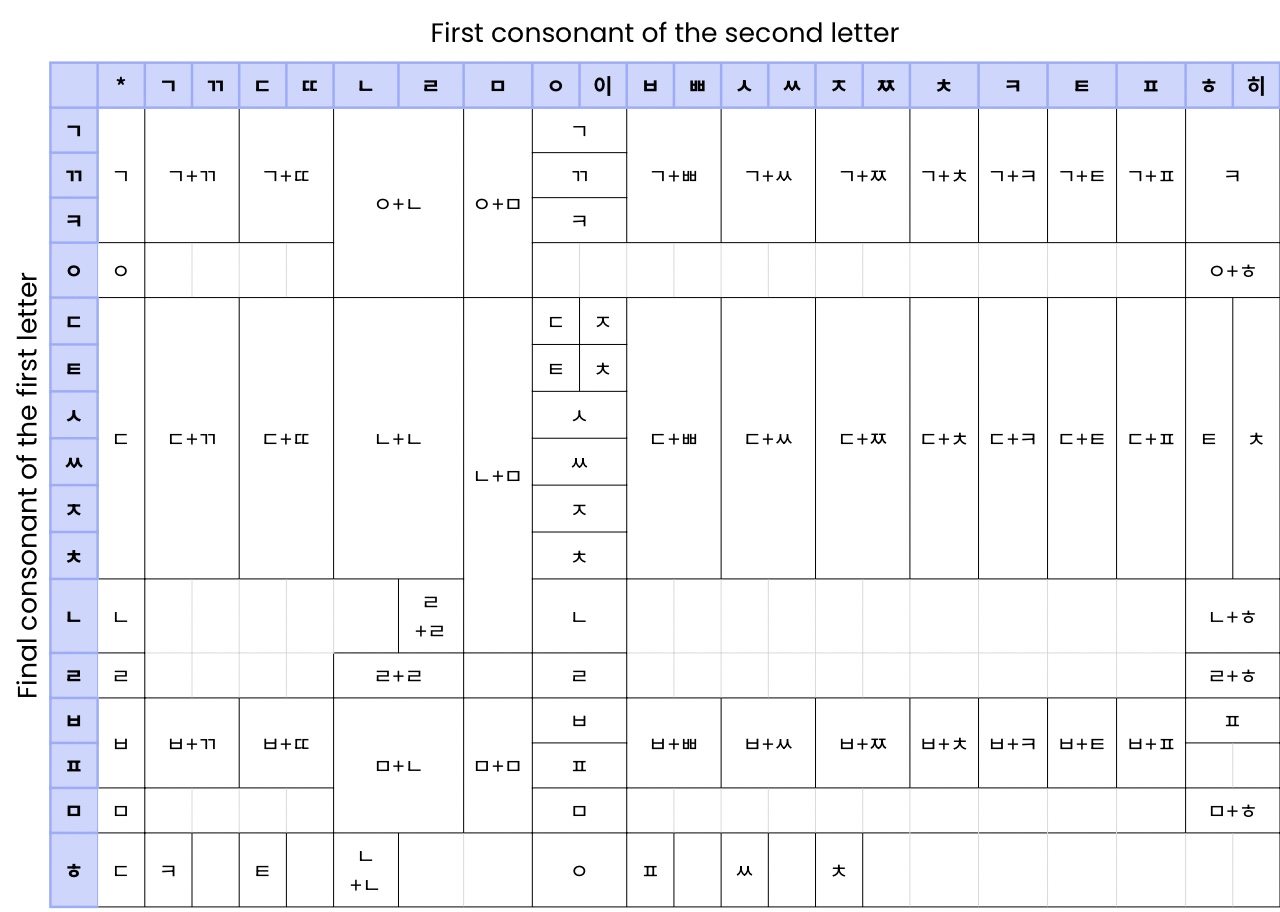
This topic may take some time to master, so please do not feel overwhelmed or demotivated if you make mistakes in pronunciation. Remember, mistakes are essential for learning. Just keep practicing, and eventually, these words will roll out naturally.
- Author: Good Job Korean team
- Editor: Good Job Korean team

